
Sample research note. This article demonstrates the intended editorial structure. It presents a framework, not new empirical findings, and contains no claimed market statistics.
Begin with a decision, not a demographic
“The Indian consumer” is an attractive phrase because it makes a very large market sound legible. It is also a risky starting point. The same household can be value-seeking in one category, convenience-led in another, and status-conscious in a third.
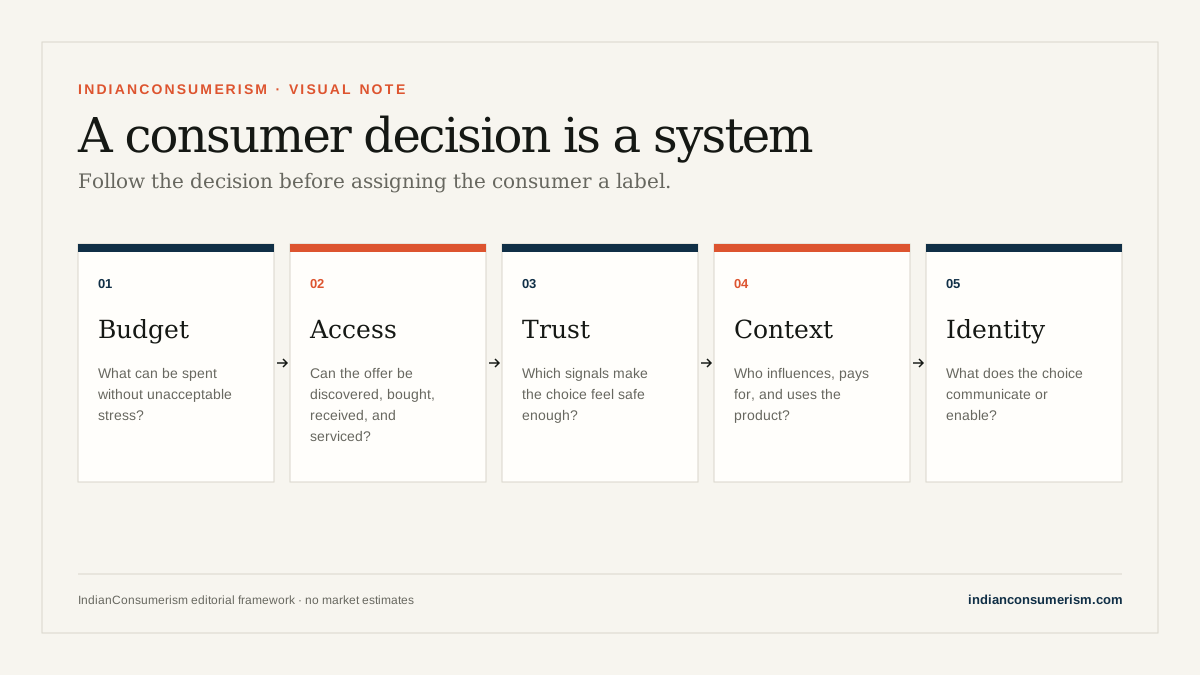
A useful unit of analysis is the decision: what is being chosen, what job it needs to do, what constraints surround it, and what alternative is currently good enough.
| Lens | Question to ask | What it can reveal |
|---|---|---|
| Income and wealth | What can the household spend without creating stress? | Affordability, financing, pack size, and risk tolerance |
| Geography | What is available, trusted, and serviceable here? | Distribution, language, climate, and infrastructure constraints |
| Generation | Which habits and reference points shaped the buyer? | Discovery, identity, technology comfort, and aspiration |
| Household | Who influences, pays for, and uses the product? | Decision roles, compromise, and frequency |
| Category | Is this purchase functional, emotional, social, or all three? | Willingness to trade up and sources of differentiation |
Segments are coordinates, not containers
Labels such as “middle class”, “Gen Z”, or “Tier 2” can help organise research, but they are not explanations on their own. The useful work begins where the labels intersect.
For example, a young consumer in a smaller city with a steady income may have high digital fluency but limited local product access. That combination creates a different purchase journey from either age or city tier alone.
A fieldwork sequence
- Define the decision and the current alternative.
- Record the practical, financial, social, and emotional constraints.
- Map how the buyer discovers, evaluates, pays for, receives, and uses the offer.
- Compare the journey across meaningful coordinates.
- Look for friction that is repeated, costly, and poorly resolved.
What makes a signal worth following
Not every complaint represents demand. Stronger signals have a visible cost: consumers spend extra time, money, attention, social capital, or risk to work around the problem.
Research principle: A workaround is often more informative than a stated preference because it shows what someone already does when the ideal option is missing.
The job of IndianConsumerism is to connect these observations with credible data, company evidence, and category context. The output should make uncertainty visible rather than hide it behind a national average.
Next research questions
- Which consumer decisions are changing fastest within a category?
- Where does digital discovery still collide with physical fulfilment?
- Which trade-offs differ most sharply by household type or city context?
- Which workarounds are common enough to justify deeper primary research?
These questions are a starting map. A published research piece would replace the sample framing with cited evidence, a defined methodology, and explicit limitations.